Author: Yildiz Culcu
-
Weekly Problem- Let’s get complex
Consider this sequence: 1, 3, 7, 15, … Each number seems to follow a simple rule, but there’s something magical happening when we look at their binary representations. This sequence demonstrates how simple patterns create complex constraints – a fundamental concept in complex systems.
-

When Pain Shapes Politics: On Discrimination, Protest, and the Risk of Misplaced Anger
It’s about how personal and collective pain—often valid and justified—sometimes spills over into debates where it clouds our ability to judge clearly. I see this pattern in feminist debates, in discussions about universities or the military, and very strikingly in the infamous O.J. Simpson trial.
-
Weekly Problem: Balls into Bins
Probability theory: Throwing balls into bins Imagine you’re at a carnival game where you’re blindfolded and asked to throw balls into bins. Simple enough, right? But here’s where it gets interesting: this simple game is actually a powerful model for understanding everything from how websites handle traffic to how computers store data. What’s Really Going…
-

Emergent Structures in AI and how body becomes mind
How does mindfulness emerge from mindless matter? How do billions of neurons firing in patterns, or millions of artificial parameters in a neural network, give rise to understanding, consciousness, and meaning? This transition from body to mind, from physical substrate to mental experience, represents one of the most fascinating frontiers in both philosophy and artificial…
-
Weekly Problem: Traffic
You’re managing a busy intersection where cars arrive from the north and east. Each direction gets a 30-second green light. Your goal is to decide which direction should get the green light next to minimize the total waiting time
-

A true man: The Truman Show
For me, The Truman Show speaks to a fundamental paradox within us: the desire for truth, the fear of it, and the strange comfort we find in illusions. It explores not just deception, but what it means to live a life that feels empty—until something real pierces through.
-
Weekly Problem: Latin Squares
Weekly Problem: Latin Squares and Experimental Design The Mystery of Latin Squares A Latin square is a grid where each symbol appears exactly once in each row and column. Simple to describe, yet they hold deep mathematical mysteries and practical applications! A B C B C A C A B Part 1: The Basic Challenge…
-
Weekly Problem: The Card Sequence Problem
Problem Statement You have three cards numbered 1, 2, and 3. You shuffle them and place them face down in a row. Question: What is the probability that at least one card is in its correct position (i.e., card number matches its position)?
-
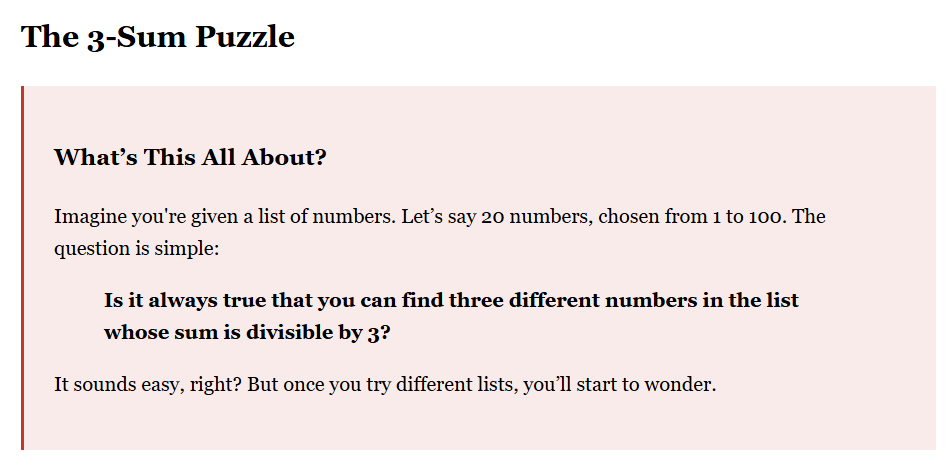
The 3-Sum Puzzle
What’s This All About? Imagine you’re given a list of numbers. Let’s say 20 numbers, chosen from 1 to 100. The question is simple: Is it always true that you can find three different numbers in the list whose sum is divisible by 3? It sounds easy, right? But once you try different lists, you’ll…
-
Solution to The Happy Ending Problem
What’s This All About? Imagine playing a game where you put dots on a piece of paper. The challenge is to find dots that can be connected to make different shapes. But there’s a catch – the shapes need to be “convex” (no dents or inward angles).
-
The Happy Ending Problem
Points, Patterns, and a Mathematical Love Story In 1933, a young mathematician named Esther Klein noticed something interesting about points on a plane. This observation led to a famous problem – and eventually to her marriage to another mathematician, George Szekeres. Hence, this became known as the “Happy Ending Problem”! This Week’s Challenge Basic Concept:…
-

She goes away-The Heroine of the Sea
Forth she comes, forth she lunges! Into new chapters, new life plunges. Into the waters after the fiery win. The Heroine of the Sea — her tale begins.
-
Weekly Problem Fermat’s Last Theorem
Fermat’s Last Theorem: The Most Famous Problem in Number Theory “I have discovered a truly remarkable proof which this margin is too small to contain.” – Pierre de Fermat, around 1637 The Statement For any integer n > 2, there are no positive integers x, y, and z that satisfy: xⁿ + yⁿ = zⁿ…
-

Have a Personal Website? Your Data May Be on These Dark Web Pages!
These sources are your place to check for data leaks Well, now that I’m starting my own business and slowly advancing my education and career, I plan to build a personal website. However, there are more things to consider than one may think. We often associate cyberattacks with large corporations or political targets, assuming personal…
-
Weekly Problem: Number Theory
The Collatz Sequence Let’s explore one of the most deceptively simple yet unsolved problems in mathematics, first proposed by Lothar Collatz in 1937. The Rules Start with any positive integer n. At each step: If the number is even, divide it by 2 If the number is odd, multiply it by 3 and add 1…
-

I turned 24 and realized these 5 things I should have learned before
Choose balance and learn to love and trust yourself Yes, today is my birthday. I am 24 years old. My name is Yildiz. I am an entrepreneur and a recipient of the EXIST Women scholarship. I am a writer. I work with the Max Planck Institute for Cognitive and Brain Sciences. I am a student…
-

Evil: Scarlett O’ Hara is the best written and most misunderstood female character
Being strong and unconventional sometimes means you can’t afford to be gentle I have not yet conducted a detailed demographic analysis of my blog readers, so I may lose some of you by introducing Scarlett O’Hara—the protagonist of Margaret Mitchell’s bestselling 1939 novel “Gone with the Wind.” This novel takes place during the American Civil…