Category: Computer Science
-
Weekly Problem: The Second-Chance Romance Strategy
The Problem You’ve just been through a tough breakup and are ready to start dating again. Over the next year, you’ll meet 100 potential romantic partners one by one. After meeting each person, you must immediately decide whether to commit to them or move on forever. Once you pass on someone, you can never go…
-
Weekly Problem #24
Bayesian Problem: The Quality Control Dilemma Background A pharmaceutical company produces a critical medication. Historical data suggests that the production process has typically maintained a defect rate of around 2%. However, recent changes in the manufacturing process have raised concerns about whether this rate has increased. The Data In a recent batch of 100 units:…
-
Weekly Problem: Knitting Patterns
Knitting Patterns: Turing Completeness and Computational Textiles Knitting Patterns as Computational Systems: Turing Completeness in Textile Production An exploration of the formal computational properties of knitting pattern languages The relationship between knitting patterns and computational systems extends beyond superficial analogy. Recent work in theoretical computer science has demonstrated that certain classes of knitting patterns constitute…
-
Solution to The Happy Ending Problem
What’s This All About? Imagine playing a game where you put dots on a piece of paper. The challenge is to find dots that can be connected to make different shapes. But there’s a catch – the shapes need to be “convex” (no dents or inward angles).
-

Weekly Problem no.14: Beethoven’s 5th!
Cryptophonic Challenge: Beethoven’s Victory Code The Cryptophonic Challenge: Beethoven’s Victory Code Click to Start Audio Engine 🎵 Decode the Victory Symphony Level: 1/3 Current Mission: Decode the famous rhythm that became a symbol of victory… Attempts remaining: 3 30s lockout remaining Pattern 1: • • • ― ❔ Pattern 2: ― • • • 🔒…
-
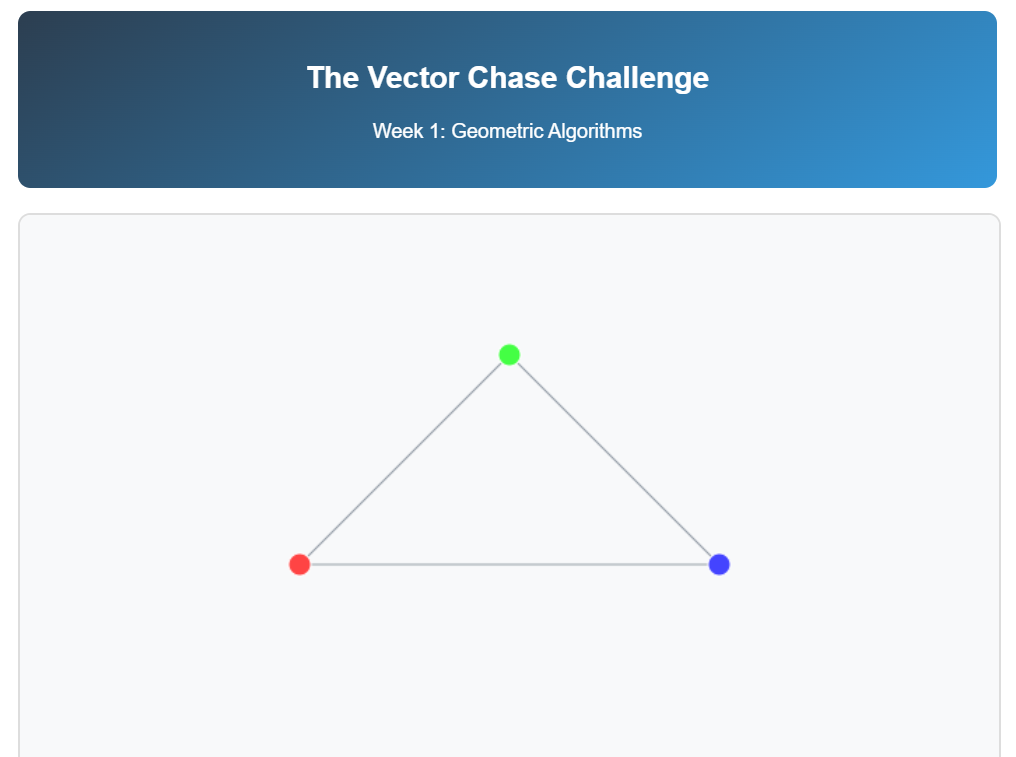
Weekly Problem no.13 Vector Chase!
Here’s our weekly mathematical problem. this time in Geometry!
-
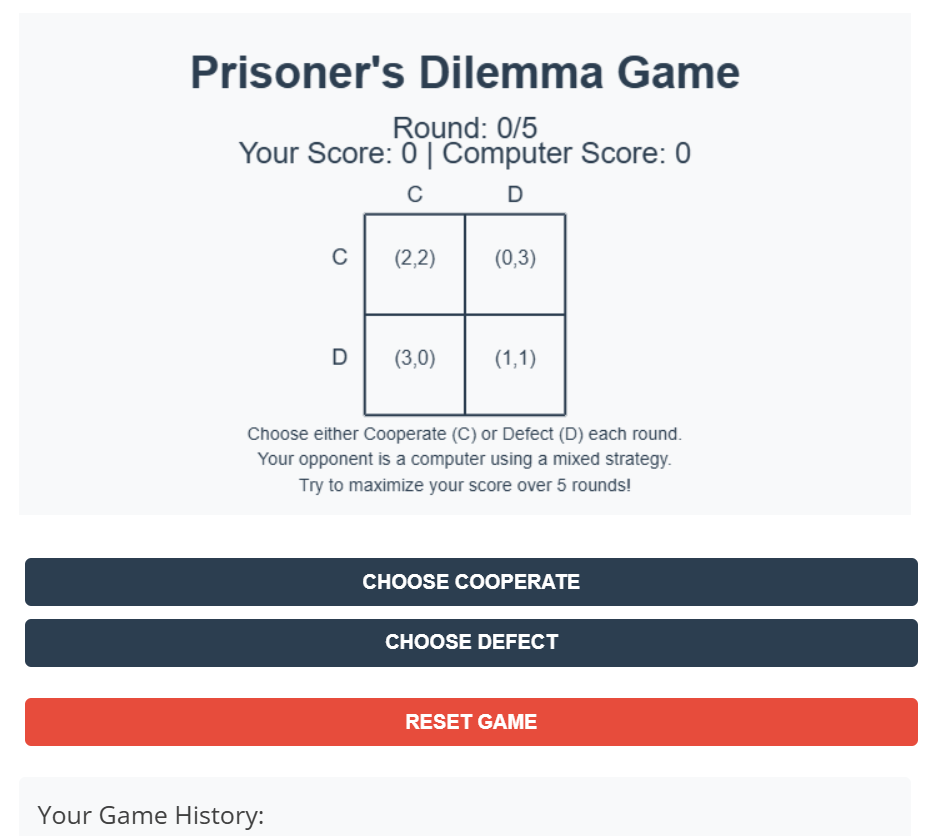
Weekly Problem No.10. The Repeated Prisoner’s Dilemma
The Prisoner’s Dilemma, first formulated by Merrill Flood and Melvin Dresher in 1950 and later formalized by Albert W. Tucker, represents one of game theory’s most profound insights into human behavior and strategic decision-making. The classic scenario unfolds as follows:
-
Liar! Weekly Problem
🤔 Philosopher A 🤯 Philosopher B “Let’s start our discussion about the Liar Paradox…” Next Step Reset The Liar Paradox is one of the oldest and most famous logical paradoxes, dating back to ancient Greece. In its simplest form, it’s captured in the statement: “This statement is false.” Understanding the Paradox: If we assume the…
-

The Dining Philosopher’s Problem
Weekly Problem No. 6 The Dining Philosophers Problem is a classic computer science problem that illustrates challenges in resource sharing and deadlock avoidance. The Setup Five philosophers are seated around a circular table. In front of each philosopher is a plate of spaghetti, their only nourishment as they ponder life’s great mysteries. Between each pair…
-
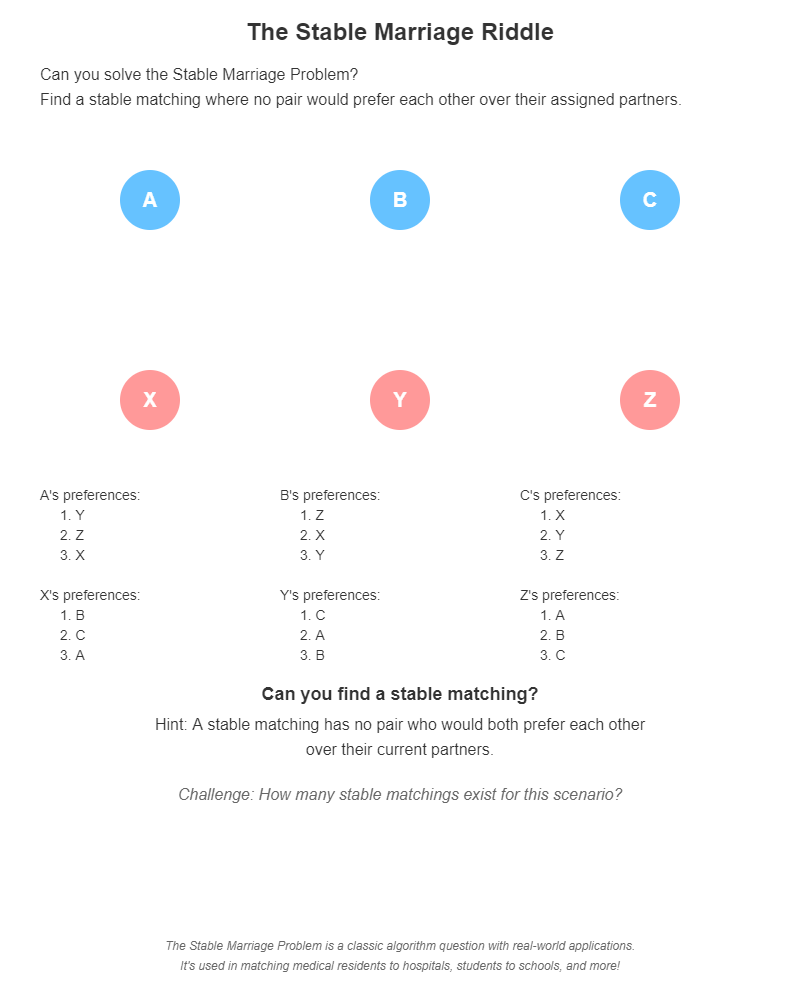
The stable marriage problem
Our weekly problem no. 3. Algorithmic problem Solutions to be published on Saturday 26/10/24! Write your thoughts in the comments! Here is the solution to the stable marriage riddle.
-

This cognitive bias is the reason people get misjudged, defamed and gaslighted
If you lack data, keep quiet. Here’s why. It’s like forming an opinion about a restaurant from one unsavory meal or questioning a medical treatment’s effectiveness due to a smattering of adverse outcomes. This phenomenon, known as “small sample bias” or the “law of small numbers,” can significantly distort our judgments and decision-making processes. It’s…
-

AI is not creative, it is just good at recycling
Can machines truly be creative? Some argue yes, pointing to AI-generated art, music, and literature. However, upon closer examination, it becomes apparent that the creativity exhibited by AI is merely a permutation of existing information rather than genuine innovation. True creativity, as exemplified by pioneers like Isaac Newton, involves the generation of new knowledge to…
-
10 Cryptographic Techniques you need to know
From Roman Empires to supercomputers Cryptography, the art of writing or solving codes, has been an integral part of human history. It has evolved from simple ciphers used by ancient civilizations to complex algorithms that secure modern digital communications. This article provides an overview of 10 different encryption methods, offering a glimpse into their historical…
-

Decision Theory and the Power of Counterfactuals
A Research team on Spotify develops a new ML model for decision-making using counterfactuals. Why that’s exciting! Self-driving cars, medical diagnosis, investment plans, and game theory are all applications of decision-making AI. Decision theory is the study of algorithms for correct decisions, but it comes with a few obstacles. Making the right decision is quite…