Category: Quiz
-
Weekly Problem #32
🔐 Weekly Puzzle Crack the Code Puzzle #28 · Caesar Cipher 🔒 Encoded Message VJG HKTUV UVGR KU VJG JCTFGUV Word spacing is preserved · only letters are shifted ✏️ Your Answer ✗ Not quite — recheck your shift and try again. Check Answer → 🎉 You cracked it! THE FIRST STEP IS THE HARDEST…
-
Weekly Problem: Seven Bridges
WEEKLY PROBLEM The Seven Bridges of Königsberg Can you cross every bridge exactly once? Difficulty: ★★★☆☆ Topic: Mathematics · Logic · Computer Science The Problem Imagine the city of Königsberg in Prussia in the eighteenth century. The city was divided by a river, with two islands sitting in the middle. Seven bridges connected the…
-
Weekly Problem: Gift Wrapping
Gift-Wrapping Algorithmus: Konvexe Hülle Berechnung Implementierung und Analyse des Jarvis-March-Algorithmus
-
Weekly Problem: New Life and Logic puzzle
Each clue corresponds to one word in the grid. The clue is obtained from the original word by applying the same transformation to all words. Reconstruct the original sentence by filling the grid so that all clues become consistent with a single transformation rule
-
Weekly Problem: Arithmetization
🔢 Arithmetization: Encoding Logic as Numbers Transform mathematical formulas into unique numbers using Gödel numbering 1 Enter a Formula ℹ️ What is Arithmetization? Arithmetization is a technique that assigns unique numbers to mathematical symbols and formulas. This allows us to treat statements about mathematics as mathematical objects themselves! This concept is crucial in proving Gödel’s…
-
Weekly Problem: Knitting Patterns
Knitting Patterns: Turing Completeness and Computational Textiles Knitting Patterns as Computational Systems: Turing Completeness in Textile Production An exploration of the formal computational properties of knitting pattern languages The relationship between knitting patterns and computational systems extends beyond superficial analogy. Recent work in theoretical computer science has demonstrated that certain classes of knitting patterns constitute…
-
Weekly Problem- Let’s get complex
Consider this sequence: 1, 3, 7, 15, … Each number seems to follow a simple rule, but there’s something magical happening when we look at their binary representations. This sequence demonstrates how simple patterns create complex constraints – a fundamental concept in complex systems.
-
Weekly Problem: Traffic
You’re managing a busy intersection where cars arrive from the north and east. Each direction gets a 30-second green light. Your goal is to decide which direction should get the green light next to minimize the total waiting time
-
The 3-Sum Puzzle
What’s This All About? Imagine you’re given a list of numbers. Let’s say 20 numbers, chosen from 1 to 100. The question is simple: Is it always true that you can find three different numbers in the list whose sum is divisible by 3? It sounds easy, right? But once you try different lists, you’ll…
-
Solution to The Happy Ending Problem
What’s This All About? Imagine playing a game where you put dots on a piece of paper. The challenge is to find dots that can be connected to make different shapes. But there’s a catch – the shapes need to be “convex” (no dents or inward angles).
-
The Happy Ending Problem
Points, Patterns, and a Mathematical Love Story In 1933, a young mathematician named Esther Klein noticed something interesting about points on a plane. This observation led to a famous problem – and eventually to her marriage to another mathematician, George Szekeres. Hence, this became known as the “Happy Ending Problem”! This Week’s Challenge Basic Concept:…
-
Weekly Problem Fermat’s Last Theorem
Fermat’s Last Theorem: The Most Famous Problem in Number Theory “I have discovered a truly remarkable proof which this margin is too small to contain.” – Pierre de Fermat, around 1637 The Statement For any integer n > 2, there are no positive integers x, y, and z that satisfy: xⁿ + yⁿ = zⁿ…
-
Weekly Problem: Number Theory
The Collatz Sequence Let’s explore one of the most deceptively simple yet unsolved problems in mathematics, first proposed by Lothar Collatz in 1937. The Rules Start with any positive integer n. At each step: If the number is even, divide it by 2 If the number is odd, multiply it by 3 and add 1…
-
Weekly problem: Solve the Morse Code Riddle
The Curious Case of the Musical Cipher “My dear Watson,” Holmes began, his eyes gleaming with interest, “we have received a most peculiar message from Inspector Lestrade. Three musical patterns, each hiding a word, and when properly arranged, will reveal the location of a stolen artifact.” 📡 Show/Hide Morse Code Reference ▼ A .- B…
-
Weekly Problem: Fallacy Fallacy
Understanding the Fallacy Fallacy Test your knowledge about the fallacy fallacy – the mistake of assuming that if an argument contains a fallacy, its conclusion must be false.
-

Weekly Problem no.14: Beethoven’s 5th!
Cryptophonic Challenge: Beethoven’s Victory Code The Cryptophonic Challenge: Beethoven’s Victory Code Click to Start Audio Engine 🎵 Decode the Victory Symphony Level: 1/3 Current Mission: Decode the famous rhythm that became a symbol of victory… Attempts remaining: 3 30s lockout remaining Pattern 1: • • • ― ❔ Pattern 2: ― • • • 🔒…
-
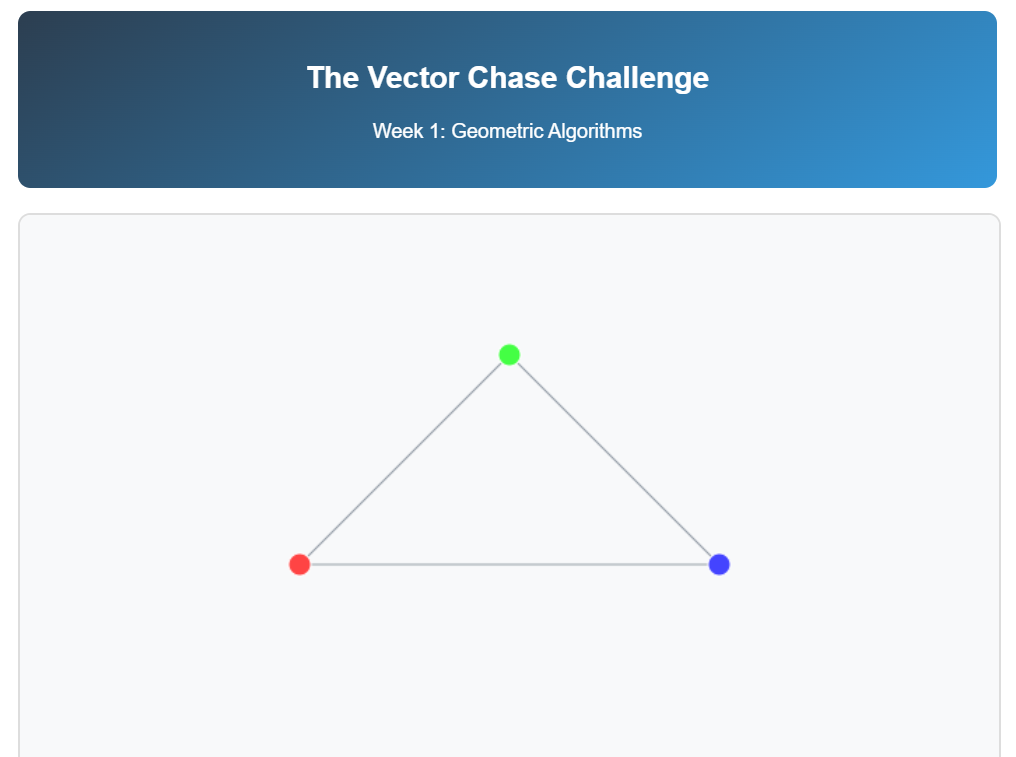
Weekly Problem no.13 Vector Chase!
Here’s our weekly mathematical problem. this time in Geometry!