Tag: Logic
-
Five Rules for Questions That Approximate Truth
The ability to ask precise questions determines how close we get to understanding reality. Poor questions produce poor answers. This chapter presents five rules for constructing questions that lead toward truth rather than away from it. Rule 1: Make Your Questions Falsifiable Connor sat in his university library in 2018, reading about the replication crisis…
-
The Equivalence of Legal Argumentation and Mathematical Proof: Why Precedent and Proof by Analogy Are the Same Thing
The Basic Structure of Legal Precedent In legal argumentation, lawyers constantly use this reasoning: In case Y, the situation was such-and-such, and the defendant was acquitted. In our current case X, the situation is like the situation in case Y. Therefore, the same argumentation that led to acquittal in case Y should apply, and the…
-
Weekly Problem: New Life and Logic puzzle
Each clue corresponds to one word in the grid. The clue is obtained from the original word by applying the same transformation to all words. Reconstruct the original sentence by filling the grid so that all clues become consistent with a single transformation rule
-
Weekly Problem: Arithmetization
🔢 Arithmetization: Encoding Logic as Numbers Transform mathematical formulas into unique numbers using Gödel numbering 1 Enter a Formula ℹ️ What is Arithmetization? Arithmetization is a technique that assigns unique numbers to mathematical symbols and formulas. This allows us to treat statements about mathematics as mathematical objects themselves! This concept is crucial in proving Gödel’s…
-
Weekly Problem: Knitting Patterns
Knitting Patterns: Turing Completeness and Computational Textiles Knitting Patterns as Computational Systems: Turing Completeness in Textile Production An exploration of the formal computational properties of knitting pattern languages The relationship between knitting patterns and computational systems extends beyond superficial analogy. Recent work in theoretical computer science has demonstrated that certain classes of knitting patterns constitute…
-
Weekly Problem- Let’s get complex
Consider this sequence: 1, 3, 7, 15, … Each number seems to follow a simple rule, but there’s something magical happening when we look at their binary representations. This sequence demonstrates how simple patterns create complex constraints – a fundamental concept in complex systems.
-
Weekly Problem: Traffic
You’re managing a busy intersection where cars arrive from the north and east. Each direction gets a 30-second green light. Your goal is to decide which direction should get the green light next to minimize the total waiting time
-
Weekly Problem: Latin Squares
Weekly Problem: Latin Squares and Experimental Design The Mystery of Latin Squares A Latin square is a grid where each symbol appears exactly once in each row and column. Simple to describe, yet they hold deep mathematical mysteries and practical applications! A B C B C A C A B Part 1: The Basic Challenge…
-
Weekly Problem: The Card Sequence Problem
Problem Statement You have three cards numbered 1, 2, and 3. You shuffle them and place them face down in a row. Question: What is the probability that at least one card is in its correct position (i.e., card number matches its position)?
-
Weekly problem: Solve the Morse Code Riddle
The Curious Case of the Musical Cipher “My dear Watson,” Holmes began, his eyes gleaming with interest, “we have received a most peculiar message from Inspector Lestrade. Three musical patterns, each hiding a word, and when properly arranged, will reveal the location of a stolen artifact.” 📡 Show/Hide Morse Code Reference ▼ A .- B…
-
Weekly Problem: Fallacy Fallacy
Understanding the Fallacy Fallacy Test your knowledge about the fallacy fallacy – the mistake of assuming that if an argument contains a fallacy, its conclusion must be false.
-
Weekly Problem: Geometric Maze Optimization
-
Weekly Problem No 12. A unified model of human biases
[raw] The Paradox of Market Street Week 1 Challenge | Deadline: Next Monday “In the bustling city of Behavoria, on the famous Market Street, a peculiar experiment is taking place…” The Scenario Three shops opened on Market Street, each selling identical coffee mugs: 🏪 Shop A: Sells mugs for $10 🏪 Shop B: Initially sells…
-

Liar! Weekly Problem
🤔 Philosopher A 🤯 Philosopher B “Let’s start our discussion about the Liar Paradox…” Next Step Reset The Liar Paradox is one of the oldest and most famous logical paradoxes, dating back to ancient Greece. In its simplest form, it’s captured in the statement: “This statement is false.” Understanding the Paradox: If we assume the…
-
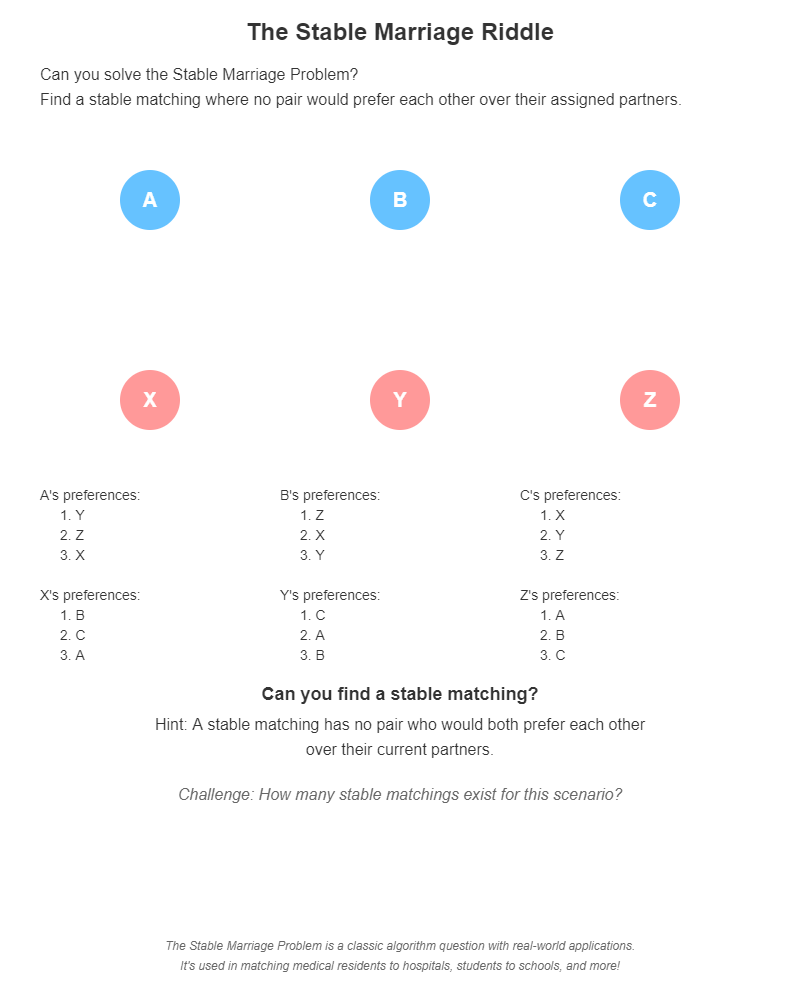
The stable marriage problem
Our weekly problem no. 3. Algorithmic problem Solutions to be published on Saturday 26/10/24! Write your thoughts in the comments! Here is the solution to the stable marriage riddle.
-

This is why most people are wrong about almost anything
The case of minimum wage laws serves as a poignant illustration of the perils of inductive reasoning. Hayek’s predictions, though grounded in economic theory and empirical observations, failed to account for the multifaceted dynamics shaping labor markets. By extrapolating from limited data and theoretical abstractions, Hayek fell victim to the inherent biases and oversights characteristic…
-

Five habits that make you more intelligent
Being smart is generally considered a great compliment and the good news is that we have some room for cognitive improvement that can simply be achieved by implementing the right habits into your weekly routine. So here are five habits that, as research indicated, make you more intelligent over time: It is challenging to define…