Tag: Mathematics
-
Five Rules for Questions That Approximate Truth
The ability to ask precise questions determines how close we get to understanding reality. Poor questions produce poor answers. This chapter presents five rules for constructing questions that lead toward truth rather than away from it. Rule 1: Make Your Questions Falsifiable Connor sat in his university library in 2018, reading about the replication crisis…
-
The Equivalence of Legal Argumentation and Mathematical Proof: Why Precedent and Proof by Analogy Are the Same Thing
The Basic Structure of Legal Precedent In legal argumentation, lawyers constantly use this reasoning: In case Y, the situation was such-and-such, and the defendant was acquitted. In our current case X, the situation is like the situation in case Y. Therefore, the same argumentation that led to acquittal in case Y should apply, and the…
-

Representation Learning in Artificial Intelligence and Neuroscience
What Is Representation Learning Representation learning refers to methods that automatically discover representations of data needed for feature detection or classification tasks [1]. In artificial intelligence, these methods learn transformations of raw input data into forms that make it easier to extract useful information when building classifiers or predictors. The core principle involves learning mappings…
-
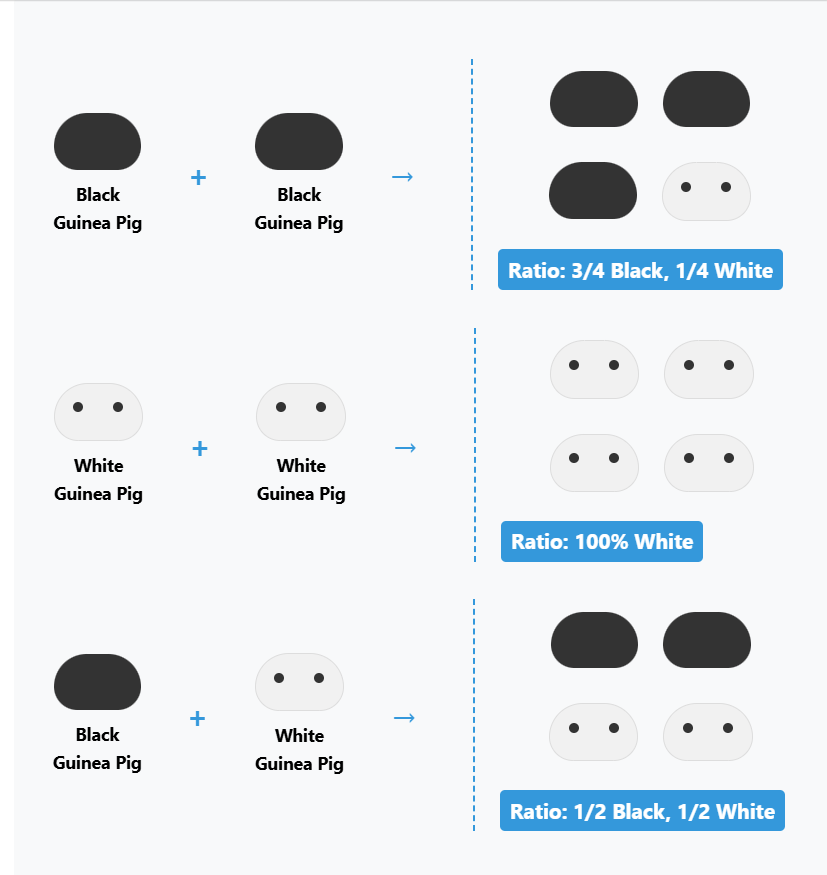
Weekly Problem: Guinea Pig Fur Color Genetics
The Problem In a laboratory study, scientists are breeding guinea pigs to understand the genetics of fur color. They observe an interesting pattern: When two black guinea pigs mate, about 3/4 of their offspring are black, while 1/4 are white.When two white guinea pigs mate, ALL of their offspring are white.When a black guinea pig…
-
Weekly Problem: The Game Show Dilemma
The problem Imagine you’re a contestant on a popular game show. The host shows you three closed doors: behind one is a brand-new luxury car, and behind the other two are goats (which, unless you’re in the market for a goat, are considerably less valuable prizes). You select Door #1, hoping it contains the car.…
-
Weekly Problem: The Second-Chance Romance Strategy
The Problem You’ve just been through a tough breakup and are ready to start dating again. Over the next year, you’ll meet 100 potential romantic partners one by one. After meeting each person, you must immediately decide whether to commit to them or move on forever. Once you pass on someone, you can never go…
-
Weekly Problem #24
Bayesian Problem: The Quality Control Dilemma Background A pharmaceutical company produces a critical medication. Historical data suggests that the production process has typically maintained a defect rate of around 2%. However, recent changes in the manufacturing process have raised concerns about whether this rate has increased. The Data In a recent batch of 100 units:…
-
Weekly Problem: Gift Wrapping
Gift-Wrapping Algorithmus: Konvexe Hülle Berechnung Implementierung und Analyse des Jarvis-March-Algorithmus
-
Weekly Problem: Arithmetization
🔢 Arithmetization: Encoding Logic as Numbers Transform mathematical formulas into unique numbers using Gödel numbering 1 Enter a Formula ℹ️ What is Arithmetization? Arithmetization is a technique that assigns unique numbers to mathematical symbols and formulas. This allows us to treat statements about mathematics as mathematical objects themselves! This concept is crucial in proving Gödel’s…
-
Weekly Problem: The Grid
Consider a 4×4 grid where each cell can be either selected or not selected. Two cells cannot both be selected if they share an edge (top, right, bottom, or left).
-
Weekly Problem- Let’s get complex
Consider this sequence: 1, 3, 7, 15, … Each number seems to follow a simple rule, but there’s something magical happening when we look at their binary representations. This sequence demonstrates how simple patterns create complex constraints – a fundamental concept in complex systems.
-
Weekly Problem: Balls into Bins
Probability theory: Throwing balls into bins Imagine you’re at a carnival game where you’re blindfolded and asked to throw balls into bins. Simple enough, right? But here’s where it gets interesting: this simple game is actually a powerful model for understanding everything from how websites handle traffic to how computers store data. What’s Really Going…
-
Weekly Problem: The Card Sequence Problem
Problem Statement You have three cards numbered 1, 2, and 3. You shuffle them and place them face down in a row. Question: What is the probability that at least one card is in its correct position (i.e., card number matches its position)?
-
The 3-Sum Puzzle
What’s This All About? Imagine you’re given a list of numbers. Let’s say 20 numbers, chosen from 1 to 100. The question is simple: Is it always true that you can find three different numbers in the list whose sum is divisible by 3? It sounds easy, right? But once you try different lists, you’ll…
-
Solution to The Happy Ending Problem
What’s This All About? Imagine playing a game where you put dots on a piece of paper. The challenge is to find dots that can be connected to make different shapes. But there’s a catch – the shapes need to be “convex” (no dents or inward angles).
-
The Happy Ending Problem
Points, Patterns, and a Mathematical Love Story In 1933, a young mathematician named Esther Klein noticed something interesting about points on a plane. This observation led to a famous problem – and eventually to her marriage to another mathematician, George Szekeres. Hence, this became known as the “Happy Ending Problem”! This Week’s Challenge Basic Concept:…
-
Weekly Problem Fermat’s Last Theorem
Fermat’s Last Theorem: The Most Famous Problem in Number Theory “I have discovered a truly remarkable proof which this margin is too small to contain.” – Pierre de Fermat, around 1637 The Statement For any integer n > 2, there are no positive integers x, y, and z that satisfy: xⁿ + yⁿ = zⁿ…